At Heritage Dental, our dentists use advanced technology, including dental lasers, to make many common treatments gentler, more precise, and easier to recover from. Laser dentistry uses a focused beam of light energy to treat gum tissue and teeth, often with less bleeding, less swelling, and less need for the drill.
Whether you need gum treatment, a cavity filled, or a tongue-tie released, laser technology helps us deliver precise care while keeping you comfortable. Many patients find that laser procedures feel quicker and heal faster than traditional methods.
How Do Dental Lasers Work?
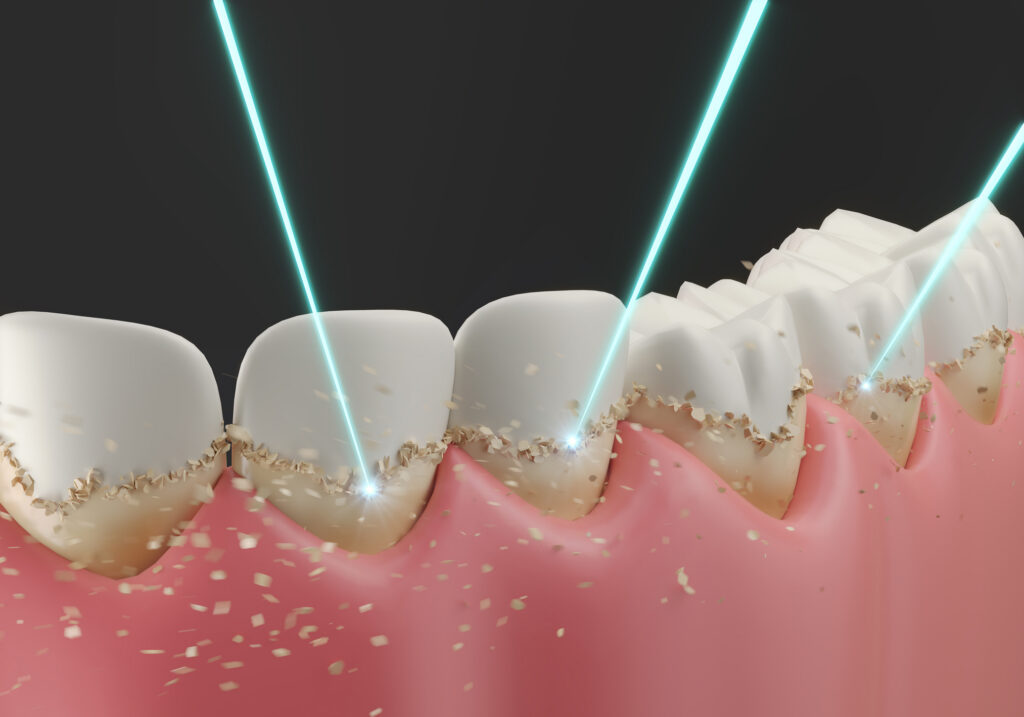
A dental laser produces a narrow, concentrated beam of light at a specific wavelength. Different tissues in the mouth absorb different wavelengths, allowing the laser to act on its target while leaving surrounding tissue largely untouched.
Depending on the wavelength and setting, a laser can gently remove or reshape tissue, seal blood vessels, and kill bacteria in the treatment area. That is why dentistry groups lasers into two main categories: soft tissue lasers for the gums and other soft structures, and hard tissue lasers for teeth and bone.
Soft Tissue Lasers
Soft tissue lasers treat the gums, tongue, cheeks, and other soft tissues of the mouth. Their wavelengths are absorbed by water and hemoglobin, so they cut and seal tissue at the same time. This reduces bleeding and often removes the need for stitches. Common types include diode and Nd: YAG lasers.
Soft tissue lasers can make common dental treatments less invasive and promote faster healing.
- Gum disease treatment: The laser removes infected tissue and reduces bacteria in periodontal pockets, helping gums reattach and heal.
- Gum contouring: We can reshape uneven gums or reduce a “gummy” smile for a more balanced appearance.
- Crown lengthening: Removing excess gum tissue exposes more of the tooth for a restoration or a better smile line.
- Frenectomy (tongue-tie and lip-tie release): A laser frees a tight frenum quickly, with minimal bleeding, for infants, children, and adults.
- Canker and cold sore relief: Laser treatment can reduce pain and speed healing of mouth sores.
- Soft tissue biopsies and lesion removal: The laser removes small growths precisely for evaluation.
- Implant and tooth exposure: Gum tissue over dental implants or unerupted teeth can be uncovered with minimal trauma.
Hard Tissue Lasers
Hard tissue lasers work on teeth and bone. Their wavelengths are absorbed by water and the mineral in tooth structure, allowing them to remove decay and shape enamel, dentin, and bone with great precision. The most common types are erbium lasers (Er: YAG and Er, Cr: YSGG), which can also treat soft tissue.
Hard tissue lasers can be used for a range of concerns and treatments.
- Cavity treatment: The laser removes decay and prepares the tooth for a filling, often without the noise and vibration of a drill.
- Preparing teeth for sealants and bonding: Laser preparation helps materials bond well to the tooth surface.
- Tooth sensitivity relief: Lasers can seal exposed tubules on the root surface that cause sensitivity to hot and cold.
- Bone reshaping: Lasers precisely contour bone during crown lengthening and some periodontal and implant procedures.
- Root canal support: Laser energy can help disinfect the canals inside the tooth.
Lasers are not the right tool for every procedure. For example, they cannot remove existing metal fillings or crowns. Your dentist will recommend the best approach for your specific needs.
The Benefits of Laser Dentistry for Patients
Laser dentistry offers real advantages that make dental visits more comfortable and recovery easier.
- Less discomfort: Many laser procedures require less anesthesia, and some need none at all.
- Less need for the drill: Reduced noise, vibration, and pressure help patients with dental anxiety feel more at ease.
- Minimal bleeding: The laser seals blood vessels as it works, keeping the treatment area clean and clear.
- Fewer stitches: Many soft tissue procedures heal well without sutures.
- Faster healing: Less trauma to surrounding tissue means less swelling and a quicker recovery.
- Lower infection risk: Laser energy kills bacteria in the treatment area.
- Precise, conservative care: The focused beam targets only the tissue that needs treatment, preserving more of your healthy tooth and gum structure.
- Shorter or fewer visits: Some treatments can be completed more efficiently with a laser.
Laser Dentistry FAQs
Is laser dentistry safe?
Yes. The FDA has cleared dental lasers for a wide range of procedures. During treatment, you and our team wear protective eyewear, and only trained professionals use the laser.
Does laser dentistry hurt?
Most patients report less discomfort than with traditional methods. Many procedures need little or no anesthesia, and post-treatment soreness is usually mild.